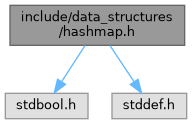
#include <stdbool.h>#include <stddef.h>
Include dependency graph for hashmap.h:
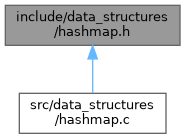
This graph shows which files directly or indirectly include this file:
Go to the source code of this file.
Classes | |
| struct | HashNode |
| Node structure representing a key-value pair in a hash bucket's collision chain. More... | |
| struct | HashMap |
| Structure representing a generic Hash Map. More... | |
Typedefs | |
| typedef struct HashNode | HashNode |
| Node structure representing a key-value pair in a hash bucket's collision chain. | |
Functions | |
| void | hashmap_init (HashMap *map, size_t bucket_count, size_t key_size, size_t value_size, unsigned long(*hash_fn)(void *), int(*cmp_fn)(void *, void *)) |
| Initializes a Hash Map structure. | |
| void | hashmap_destroy (HashMap *map) |
| Destroys the Hash Map and frees all allocated buckets, nodes, and stored data. | |
| bool | hashmap_insert (HashMap *map, void *key, const void *data) |
| Inserts a new key-value pair into the Hash Map. | |
| bool | hashmap_remove (HashMap *map, void *key) |
| Removes a key-value pair from the Hash Map by key. | |
| bool | hashmap_update (HashMap *map, void *key, const void *new_data) |
| Updates the value associated with an existing key in the Hash Map. | |
| void * | hashmap_get (HashMap *map, void *key) |
| Retrieves the value associated with a given key. | |
| int | hashmap_size (const HashMap *map) |
| Retrieves the total number of key-value pairs stored in the Hash Map. | |
Typedef Documentation
◆ HashNode
Node structure representing a key-value pair in a hash bucket's collision chain.
Function Documentation
◆ hashmap_destroy()
| void hashmap_destroy | ( | HashMap * | map | ) |
Destroys the Hash Map and frees all allocated buckets, nodes, and stored data.
- Parameters
-
map Pointer to the HashMapto destroy.
◆ hashmap_get()
| void * hashmap_get | ( | HashMap * | map, |
| void * | key | ||
| ) |
Retrieves the value associated with a given key.
- Parameters
-
map Pointer to the HashMap.key Pointer to the key to search for.
- Returns
- Pointer to the stored value data if found, or NULL if the key does not exist.
◆ hashmap_init()
| void hashmap_init | ( | HashMap * | map, |
| size_t | bucket_count, | ||
| size_t | key_size, | ||
| size_t | value_size, | ||
| unsigned long(*)(void *) | hash_fn, | ||
| int(*)(void *, void *) | cmp_fn | ||
| ) |
Initializes a Hash Map structure.
- Parameters
-
map Pointer to the HashMapstructure to initialize.bucket_count Initial number of buckets to allocate. key_size Size of the key data in bytes. value_size Size of the value data in bytes. hash_fn Pointer to the hash function for keys. cmp_fn Pointer to the key comparison function (should return 0 when keys match).
◆ hashmap_insert()
| bool hashmap_insert | ( | HashMap * | map, |
| void * | key, | ||
| const void * | data | ||
| ) |
Inserts a new key-value pair into the Hash Map.
- Parameters
-
map Pointer to the HashMap.key Pointer to the key to insert. data Pointer to the value associated with the key.
- Returns
trueif the insertion was successful, orfalseon memory allocation failure or duplicate entry depending on implementation behavior.
◆ hashmap_remove()
| bool hashmap_remove | ( | HashMap * | map, |
| void * | key | ||
| ) |
Removes a key-value pair from the Hash Map by key.
- Parameters
-
map Pointer to the HashMap.key Pointer to the key to remove.
- Returns
trueif the key was found and removed,falseotherwise.
◆ hashmap_size()
| int hashmap_size | ( | const HashMap * | map | ) |
Retrieves the total number of key-value pairs stored in the Hash Map.
- Parameters
-
map Pointer to the HashMap.
- Returns
- Total number of items stored.
◆ hashmap_update()
| bool hashmap_update | ( | HashMap * | map, |
| void * | key, | ||
| const void * | new_data | ||
| ) |
Updates the value associated with an existing key in the Hash Map.
- Parameters
-
map Pointer to the HashMap.key Pointer to the key whose value should be updated. new_data Pointer to the new value data.
- Returns
trueif the key was found and updated,falseif the key does not exist.